Friday, September 9, 2016

Notebook sketches, Pedraza

Pedraza is a small, medieval, walled village in the province of Segovia, northwest of Madrid. It sits atop a hill overlooking the rolling Castilian landscape.


It has a castle which is visible in the image above towards the right background. It was originally built in the 1300s, rebuilt in the 1500s and after a long history of change of owners, it fell into a sad state of ruin and was bought in 1926 by the painter Ignacio Zuloaga who renovated one of its towers and transformed it into his studio. It now houses a museum showcasing his work as well as Flemish still lifes from the 17th century, an El Greco original as well as one of Goya. Not bad as an attraction for a little-known village forgotten by time.


Ignacio Zuloaga Zabaleta
Spanish Basque born in Eibar, Guipuzcoa in 1870 and died in Madrid in 1945.
(With a name like that, it´s safe to say he was probably last in his class´ roll call)

He was a contemporary of Sorolla,  completely different in vision, style, and brushwork. The Valencian painter, I think, received more international acclaim and is always mentioned in the same breath as Sargent and Zorn. But we must´t overlook this artist from the same era-- here are some of his works:


I visited Pedraza the other day with family and was able to do some watercolour sketches in my notebook. It´s a pretty little village and definitely worth the visit if only for the castle and the medieval jailhouse.


Tuesday, September 6, 2016

"Con luz de bodega..."

...which translates into "with the light of a cellar"-- hence the term "bodegón" in Spanish which is the more colloquial way of saying "still life" ("naturaleza muerta"). Apparently, most if not all still lifes painted when the term "bodegón" was coined featured this somber light mostly found in cellars  which shed on the inanimate objects that characteristic play of chiaroscuro which we have all learned to associate with this genre. This is still the lighting I prefer, personally, whether it be natural (in which case one is limited to working on the subject at only certain times of the day) or artificial (in which case the whole set up is more controlled and the artist has more freedom to work when they please).

I have recently finished two of these "bodegones" done in this type of light. In both cases I have chosen natural light controlled by adjusting the blinds in the studio and so I only had two and a half hours or so to work on them each session. Both are oil on panel -- I had a surplus of particle board available which I had to prime with more layers of primer than usual as well as being careful to seal the edges.

This is the first one. I started out with a more-careful-than-usual drawing...I don´t usually finish my preliminary drawings to this extent--I was just having too much fun with it. In fact, people were telling me to leave it as a drawing and not go further.


I went on anyway and finished it. I wanted it to be of a more permanent medium than charcoal since it is something of a testimony to the tools of our trade.


...and this was what my set up looked like...


The second one is very similar but smaller in size and simpler in the sense that it contains less elements. I like this little jug a lot. Very common ceramic object over here and another piece that is just quite autonomous and has a lot to say if you let it.


...and my set up. The same "shelf", same light source, same time of day as the other painting. Wonderful thing about still life set ups: they can be manipulated exactly the way you want, they don´t need rest periods, they never complain about your choice of music and, best of all, they don´t have an opinion on the finished painting!


Friday, October 9, 2015

Slide show...selected altarpieces


I´ve come up with a slide show of selected altarpieces I´ve done over the years as a liturgical painter, and it has been brought to my attention by blog reader Mike McCarty, fellow artist/ expert photographer/ ace pool player, that  I should share this with you readers. So, my wife converted the presentation into a video and here it is...


Thursday, September 17, 2015

End result

I´ve finished the 4-meter painting I was working on recently...it now awaits packaging and shipping safely (I hope) in another, more spacious workshop...

This is how it looks finished:


...and some recent bread: A basic white, rustic sourdough... 


...and a wheat and rye sourdough loaf with oat flakes...


This is how the crumb of the rye loaf looked like. A bit tighter since I wanted it to be more of a sandwich loaf and not one with big airy holes.


Wednesday, September 2, 2015

Asturias sketches

Was up north in Asturias with the family these past couple of weeks. Did some sketches of the area we were in while there. Beautiful region, Asturias, combining mountain and sea. Only wish I was able to do more...


A view of some of the mountains around Fios, in the  area of Parres.


                                              ....and my set-up...

A valley seen from behind the town church of Fios.


Casa Cueto. A house built in the 1700s in the hamlet of Villar de la Cuesta in the area of Parres.
                                                                                                         ...and my set-up...


Ruins of an old barn in Fios.
                                                                                                      ....and my set-up... 


Playa de la Atalaya in Ribadesella. In the distant horizon you can see the cliffs of Cuerres.


The medieval bridge in Cangas de Onis (without the ever-present throng of tourits).


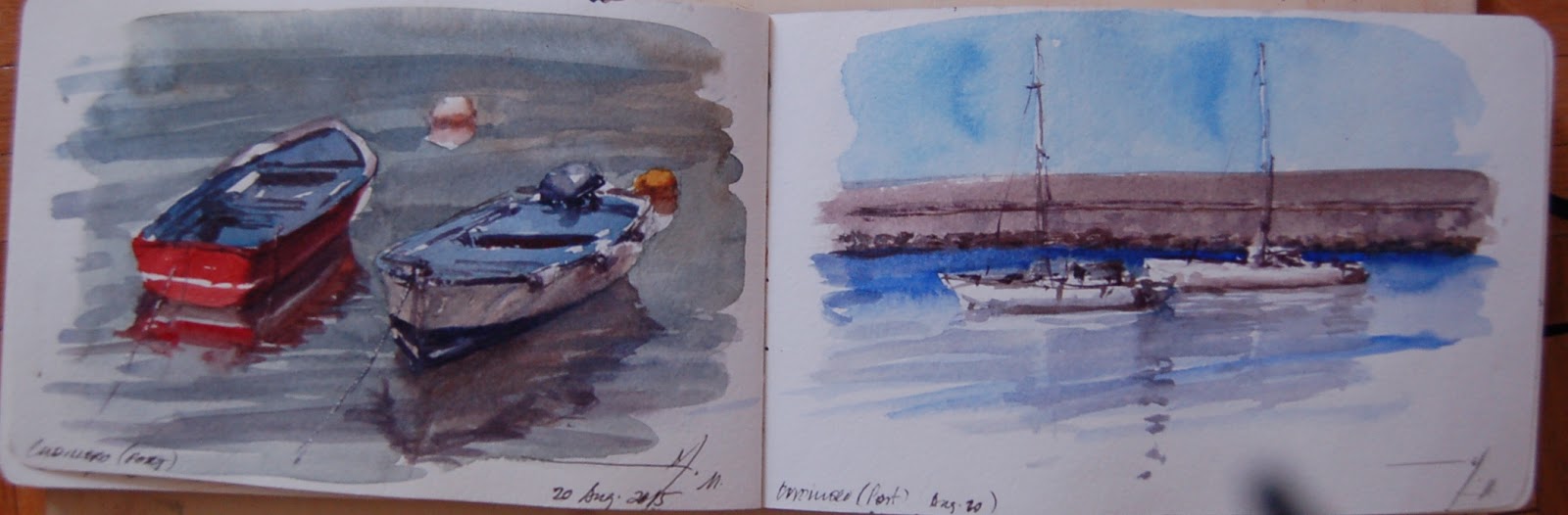
Then there were some quick notes in my watercolor notebook...

 The main beach in Ribadesella.

Some boats anchored in the port of Cudillero.

 The beach at Lastres.

 The town church of Fios,
A fountain in the grounds of the Basilica of Covadonga.


Sunday, August 9, 2015

On the scaffold again

...but a shorter one this time.
I find myself these days dealing with a four-meter canvas, a baby brother to the eight-meter panels of a couple of years ago. This time around it is for the Papal Nunciature in Equatorial Guinea. The theme is a sort of cross between a Ressurection and an Ascension, with symbols of Christ as King and Judge, surrounded by multiple cherub figures. The composition is not mine, I was asked to follow one designed by another and agreed upon with the client, but I did modify the poses in some of the figures and the arrangement of the cherubs is completely mine.
The space I am working in is the old theater of the town near where I live and is now the property of the parish there and they were gracious enough to let me use the space which has a ceiling that can  accommodate the height of the stretcher.


And the initial design laid in with all the major elements...


Here are some selected progress shots...


And some close-up details...


...and so on...
I´ll have to get back to you on the finished product. I hope to do that soon...!


Saturday, August 8, 2015

Back at the easel

Boy, it´s  been a while...!

Actually, contrary to what it may seem, the year has been quite "painting-y" so far and I´ve had to juggle the day job and a few painting commissions in such a way that it has been feeling more occupationally schizophrenic than usual: cables have been crossing, worlds have been colliding...! And there simply haven´t been enough hours in the day to sit down and update.

Anyway, I wanted to share three small commissions that have come my way, two of them of religious themes and one landscape.
The first of the two religious themes was a representation of St. Rocco (San Roque in Spanish) for a cofradia or Brotherhood in the small village of Vinuesa in the province of Soria. It was meant to replace an older depiction of the saint in a standard the brotherhood uses in processions on his feast day. Saint Roch or Rocco lived and died in the 1300s and his feast is usually celebrated on the day he was said to have died, the 16th of August.  He was a Christian saint and confessor  and he is specially invoked against the plague on account of his tending to those sick of this disease. Eventually, he too fell ill and had to be banished from society, living as a hermit in the woods somewhere subsisting on bread that was brought to him miraculously by a nobleman´s dog (whose name, according to some sources -- beats me as to how it came to be known-- was Melampo ). So the Brotherhood wanted a traditional depiction of the holy man, normally represented as a pilgrim with the pilgrim´s hat of St. James, together with Melampo bringing him a piece of bread, and with the saint showing off one of his wounds resulting from the plague. This is what I initially showed the clients as a first idea, playing around with several poses and so on...


...They eventually opted for a combination of the second and third ideas, the pose of the saint in the third and the seated dog of the second.  So off I went and started on the oil...This is how it looked with the colors blocked in and the face of St. Rocco starting to develop its final features.
        

...and this is how it looked finished...


I used the landscape we have around here in our area as a background for the scene. I figured his area must have looked quite similar.

The second religious subject I was asked to do was a depiction of Mary the Un-doer of Knots. The client is a good friend as well as an ex-student of mine back in the days when I used to do some drawing and painting instruction, and who now lives in San Diego. I must confess that, despite my many years specializing in Liturgical Art, I was totally unfamiliar with the Marian title "Un-doer of Knots". The devotion is originally German, apparently, and you may read about its history  (click here)  . I was grateful to have been given some freedom in representing this theme, not having to merely execute a copy of the original image. So this is what I came up with...


That´s a black mamba Our Lady is stepping on, by the way...I had to look that one up, I´m not exactly the go to person for animals. I was pretty pleased with the way this one turned out as it gave me a chance to play around with drapery as well as the human figure. 

And the third piece is the Toledo city scape I had been working on in the Spring and which was the subject of previous posts. Here is the final product.


And recently I´ve been asked to paint and have been working on a four-meter painting--another religious motif for the Papal nunciature in Equatorial Guinea in Africa.....more in the next post...